



24 Mar Deer Ticks vs. Dog Ticks: How to Tell the Difference and Why It Matters
You found a tick on your arm, on your child, or on your dog. Now what? Before you panic, it helps to know what kind of tick you are dealing with. Not all ticks carry the same diseases, and not all of them pose the same level of risk to your family.
In Fairfield County, the two most common ticks homeowners encounter are deer ticks and dog ticks. They look different, behave differently, and carry different diseases. Knowing how to tell them apart can help you make better decisions about treatment, medical follow-up, and how urgently you need to act.
The Deer Tick (Black-Legged Tick)
The deer tick, also called the black-legged tick, is the one that keeps Fairfield County homeowners up at night, and for good reason. This is the tick responsible for spreading Lyme Disease, along with several other serious illnesses.
What It Looks Like
Deer ticks are small. Adult females are roughly the size of a sesame seed before feeding, and males are even smaller. Nymphs, which are the juvenile stage most responsible for transmitting Lyme Disease to humans, are about the size of a poppy seed. That tiny size is what makes them so dangerous. Many people never see or feel the nymph that bites them.
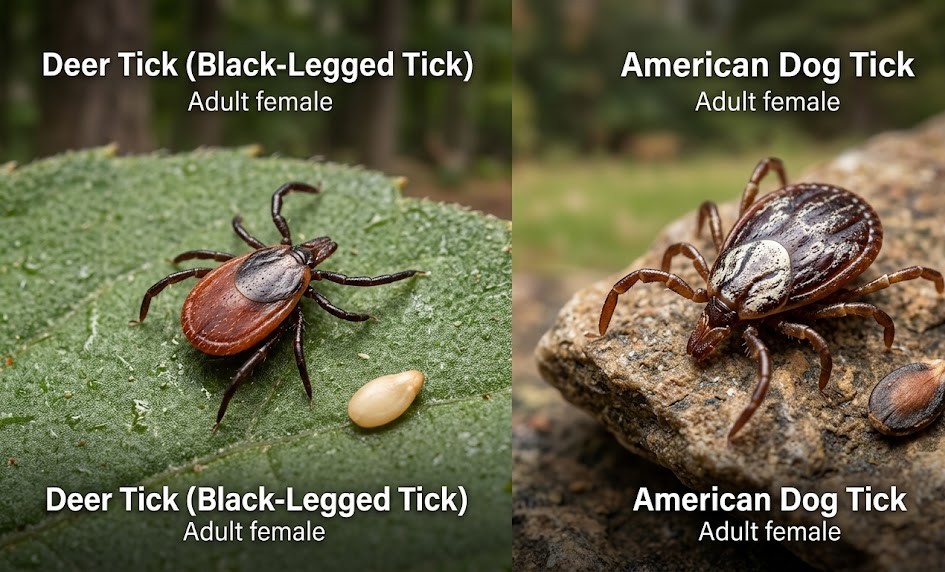
Adult female deer ticks have a reddish-brown body with a dark brown or black plate (called a scutum) near the head. Males are almost entirely dark brown or black. Their legs are noticeably dark compared to the rest of the body, which is where the name “black-legged tick” comes from.
The key visual trait: deer ticks have a smooth, tear-drop shaped body with no markings or patterns on the back.
What Diseases It Carries
This is where the deer tick stands apart. In Connecticut, deer ticks can transmit:
Lyme Disease is the most well-known and most common. It is caused by the bacterium Borrelia burgdorferi and can lead to joint pain, fatigue, neurological problems, and heart issues if not treated early.
Anaplasmosis causes fever, headache, muscle pain, and chills. It can become serious in older adults or people with weakened immune systems.
Babesiosis is a parasitic infection that attacks red blood cells. Many people show no symptoms, but it can be severe or even life-threatening for some.
Powassan virus is rare but extremely dangerous. Unlike Lyme Disease, which requires hours of tick attachment to transmit, Powassan virus can be transmitted in as little as 15 minutes.
A single deer tick bite has the potential to transmit more than one of these infections at the same time.
When It Is Active
Deer ticks in Fairfield County are active during three main periods. Nymphs are most active from late spring through summer (May through July). Adults become active in the fall (October through November) and again in early spring (March through May). On mild winter days when temperatures climb above freezing, adult deer ticks can still be out looking for a host.
This long active season is one of the reasons regular tick spraying throughout the year is so important in this area.
The American Dog Tick
The American dog tick is the other common tick found on people and pets in Fairfield County. While it is a nuisance and can carry some diseases, it is generally considered less dangerous than the deer tick.
What It Looks Like
Dog ticks are noticeably larger than deer ticks. An unfed adult female is about the size of a small watermelon seed. After feeding, a dog tick can swell to the size of a grape, making it much easier to spot than a deer tick.
The easiest way to identify a dog tick is by the markings on its back. Adult females have a large, dark brown body with a whitish or silvery shield-shaped pattern near the head. Males have a mottled brown and white pattern across their entire back.
The key visual trait: dog ticks have visible white or cream-colored markings on their back. Deer ticks do not.
What Diseases It Carries
Dog ticks do not carry Lyme Disease. This is an important distinction. If you positively identify a tick as a dog tick, Lyme Disease is not a concern from that particular bite.
However, dog ticks can transmit other illnesses. Rocky Mountain Spotted Fever is the most notable, though it is uncommon in Connecticut. Dog ticks can also cause Tularemia, a bacterial infection that can be serious if untreated.
While these diseases are worth knowing about, the overall disease risk from a dog tick bite in Fairfield County is significantly lower than from a deer tick bite.
When It Is Active
Dog ticks are most active from April through August. They prefer open, grassy areas and are commonly found along trails, in meadows, and in yards with tall grass. Unlike deer ticks, dog ticks are not typically active in the fall or winter.
Side by Side: How to Tell Them Apart
Here is a quick comparison to help you identify what you are looking at:
Size: Deer ticks are smaller (sesame seed sized). Dog ticks are larger (watermelon seed sized or bigger).
Color and markings: Deer ticks are uniformly dark with no back markings. Dog ticks have distinctive white or cream patterns on their backs.
Legs: Deer ticks have dark, almost black legs. Dog ticks have lighter brown legs.
Shape: Deer ticks have a smooth, oval, tear-drop shape. Dog ticks are rounder and flatter with a more defined shield near the head.
Body after feeding: A fed deer tick turns grayish and expands slightly. A fed dog tick turns gray or olive and can swell to a much larger size.
If you are unsure, save the tick in a sealed plastic bag with the date written on it. Your doctor or local health department may be able to identify it or send it for testing.
Why Identification Matters
Knowing whether you pulled a deer tick or a dog tick off your child, your pet, or yourself changes what you should do next.
If it is a deer tick, especially a nymph that may have been attached for a while, you should monitor for symptoms closely. Watch for a bullseye rash, fever, fatigue, joint pain, or headaches over the next few weeks. Contact your doctor if any of these appear. Some doctors may recommend a preventative dose of antibiotics after a confirmed deer tick bite, particularly if the tick was engorged or attached for more than 24 hours.
If it is a dog tick, the risk of serious illness is much lower. You should still clean the bite area and keep an eye on it, but the urgency is different.
In both cases, proper removal matters. Use fine-tipped tweezers, grasp close to the skin, and pull straight up with steady pressure. Do not twist or crush the tick.
Both Ticks Live in Fairfield County Yards
Whether it is a deer tick or a dog tick, neither one belongs in your backyard. Both species thrive in the same types of environments common across Fairfield County: yards that border woods, properties with tall grass, areas with leaf litter and ground cover, and landscapes near stone walls and brush piles.
Professional tick control treatments target both deer ticks and dog ticks. A consistent spraying schedule throughout the active season reduces the population of all tick species on your property, giving your family and pets a safer outdoor space.
Maintaining a clean, well-kept lawn also helps. Ticks avoid sunny, dry, short grass. Pairing your tick spraying with a solid lawn care and fertilization program creates an environment that is far less hospitable to ticks of any kind.
Know What You Are Dealing With
Finding a tick is never a pleasant experience. But taking a few seconds to identify what type of tick it is can help you respond appropriately, avoid unnecessary stress, and know when medical attention may be needed.
In Fairfield County, the deer tick is the one to watch out for. It is small, hard to spot, and carries the diseases that make this region one of the highest risk areas in the country. A dog tick is a nuisance, but it is not the same threat.
Either way, the best approach is prevention. Keep your yard treated, check your family and pets daily, and know what to look for.
Have questions about protecting your property from ticks this season? Reach out to Neverdousky Brothers for a free consultation.